
Inside King Charles's Return to Work
Plus buying clothes when you don't love buying clothes.

This week at work I’ve been thinking about how King Charles returned to public-facing duties.
When the King waved to assembled media outside the University College Hospital’s Macmillan Cancer Centre yesterday there were lots of reasons to be positive. The fact that the sun was out, and for the first time in months there wasn’t a chill in the air, felt somewhat symbolic as the King marked his return to public-facing duties.
The engagement had been anticipated with a bang the Friday before when Buckingham Palace had issued media with information at 1.30pm, embargoed until 6pm, that doctors felt he was able to up his workload. In a move that is worthy of note, the Palace went for a full-scale ‘back to action’ announcement rather than the more circumspect approach of committing the King to events one at a time. Clearly delighted to be able to provide some upbeat news after weeks of difficult announcements, there was a press release about a “number of external engagements” coming up, a new image to mark the first anniversary of the Coronation, and information about how encouraged his medical team are by his progress. The relatively long notice ahead of the embargo lifting, and the embargo time of 6pm to coincide with evening news bulletins, all felt designed to give the uplifting news maximum impact.
But you didn’t have to read too far between the lines to see that there is also reason to remain cautious. This will not be the same as a full summer programme, the Palace said. So far they have only committed the King to the Japanese State visit in late June beyond his first engagement, with everything else tbc. His cancer treatment, they said, still continues.
Nevertheless there was a buzzy feeling on Tuesday morning outside the hospital as media assembled to cover the visit. As I arrived to the usual faces of royal journalists, as well as some journalists from international outlets that I had not come across before, I felt a certain familiarity resuming. After weeks of unchartered territory and unprecedented circumstances, this was being back on a more sure footing. The presence of royal superfan John Loughrey, who told me he last saw the King at the Coronation, completed the sense of occasion.
As is often the case with royal visits in the centre of cities, there were multiple things going on ahead of the King and Queen’s arrival. The working hospital remained functioning, with patients coming and going as the designated press area across the road began to fill up. There was a police presence which was not overwhelming but definitely visible. There were some members of the public who were in the area and stopped to watch. Some media took their positions early and others hung back chatting until closer to the arrival. But by the time the King and Queen pulled up at 11.10am, everyone was in place.
There was an atmosphere of concentration and calm rather than buoyancy outside the venue. The King was clearly delighted to be back, waving as the cameras clicked. He acknowledged Sky News journalist Rhiannon Mills when she asked him how he was feeling and turned to pose for the media. Charles has often been accommodating when it comes to making sure photographers get their shot, but it felt yesterday like the time in front of the wider press pack outside was just that little bit longer.
Speaking to people afterwards, there was a sense that the visit had extra resonance with the King also being a patient himself. University College London Hospital’s Chief Executive David Probert was interviewed by journalists outside afterwards and described it as “uplifting,” adding that he felt patients could tell they were talking to someone who had also been through a difficult time.
The King was keen to highlight the importance of early intervention, his team told media. He was keen also to talk about innovation in treatment. Amidst the information given yesterday was also the guidance that, while the King has returned to work, every patient is different and each must follow their own path.
For now, the King’s path seems to be on an upward trajectory, with his doctors very pleased with his progress and allowing him to greet larger crowds. However, how exactly the next few weeks will pan out is still far from certain.
This Week I Wore Purple
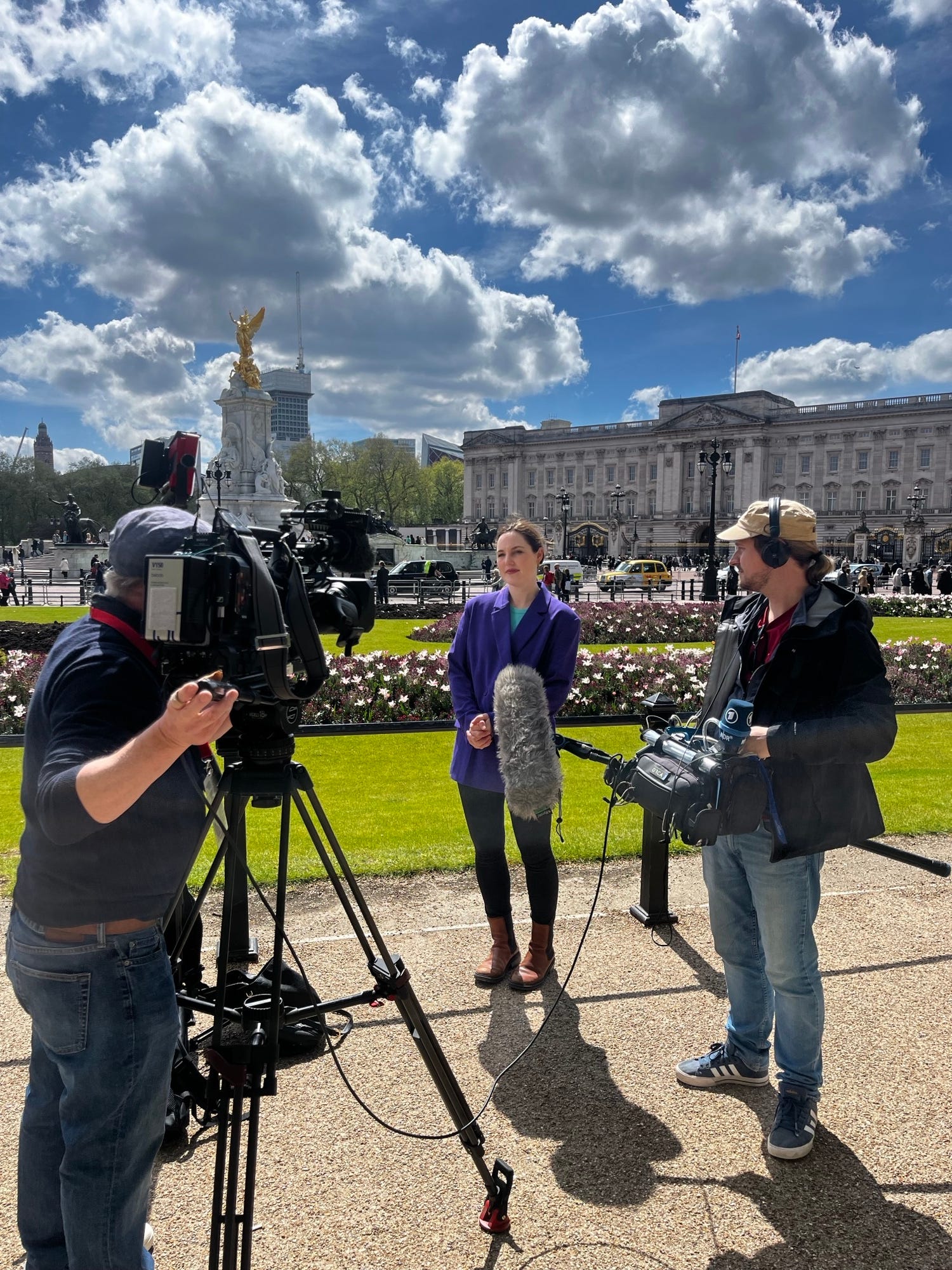
This week at home I’ve been thinking about clothes that make me feel good.
I feel I should start this post by immediately pointing out that I am not really into clothes. I’m actually terrible at buying them. I am the kind of person who would gleefully spend my money on nice food and drink but um and ah for ages about whether to part with £10 for a T-shirt. I never really feel sure I know what suits me and I constantly mean to upgrade my wardrobe or identify more of a personal style, but always end up prioritising something else.
However, one area where I have become more focused about clothes is when it comes to what to wear on television. Since I started to appear on television, which was around a decade ago, I began to pay attention to what I think works for me on camera and what it’s better to avoid. Interestingly, I found that seeing myself on screen has actually given me a much stronger sense of what I think suits me over looking in a mirror.
For me, it’s all about the bright, block colours - jewel colours as one producer once described them to me. Bright reds, bright purple, royal blue and turquoise have all served me well in my years of talking on air about the royal family. Over the years there have been certain items that I have become particularly attached to and that I think of as my feel-good clothes.
I had this in mind when I purchased a few new things recently after appearing in a documentary in an emerald green top that I realised had become a bit of an on-air uniform for me and deciding it was time to mix it up. I have never understood the concept of shopping as a leisure activity so my favourite way to buy things is to order online in as little time as possible. This definitely has its downsides and more than once I have ended up wishing I had put more thought into a purchase.
But this week I was delighted with my choice of cut-price purple French Connection blazer that is just the right mix of tailored, comfortable, professional and youthful (I mean, I’m sure that no fashion journalist would ever use a description like this but I’m going with it). So far I have worn it on television three times, to a drinks party for a royal correspondent’s leaving do, to a dinner with my husband and to cover King Charles’s first public visit. I have had people tell me it’s a great colour and asked me where it’s from. I like it so much that I have looked to see if they do it in a different colour (I got bored of this search after about 15 minutes but couldn’t find anything) and also contemplated how many days in a row I can wear it for.
So while I started this post by saying I am not really into clothes, I think what I have realised is that I am into some clothes. Covering the fashions of royal women has made me acutely aware that, like it or not, what we wear does have an impact on how people see us and the message we can send out into the world. There is more of a fixation with what royal women wear than men, but it is also true for men that an impression is created with a choice of outfit.
I don’t think I will ever be someone who delights in looking at, buying or discussing clothes. But I am definitely someone who has learned to appreciate the value of a good blazer.
I am with you on clothes as afterthought but recently read a quote along the lines of fashion being the one art form everyone participates in in some form or another, which stuck with me and made me think! The royals are certainly at the vanguard of fashion as communication - the women of course but the King is also very fashionable in his own way. As a survivor myself I thought it was incredibly touching that he sat with people during their treatments (normally such an isolating experience) and they must have felt so understood and seen. I hope he continues to raise awareness for the experience of treatment and survivorship.